GST was a 6% tax on almost everything Malaysians bought, and it ended in 2018. SST replaced it: a narrower tax that only businesses registered with Customs may charge, mostly once they pass a sales threshold. A service charge is not a tax at all. It is a fee the business adds, usually 10%, it must be shown before you order, and the money is meant for the staff. Here is who can charge each one, and how to check your bill.
The three at a glance
| GST | SST | Service charge | |
|---|---|---|---|
| Is it a tax? | Yes, ended 2018 | Yes | No, a business fee |
| Rate | 6% (0% from June 2018) | Service tax 6% or 8%; sales tax 5% or 10% | Usually 10%; no legal rate |
| Who can charge it | GST-registered businesses | Only businesses registered with Customs | Any business that shows it before you order |
| Where the money goes | Government | Government (Customs) | Meant for the staff |
| On receipts today? | No | Yes | Yes |
GST: the tax that is gone
The Goods and Services Tax started on 1 April 2015 at 6%. It was charged at every step of the supply chain, from supplier to shop to you. Each business then claimed back the GST it had paid on its own costs. The rate was cut to 0% on 1 June 2018 (EY), and SST took over on 1 September 2018.
The big difference is reach. In 2018 the Ministry of Finance said GST covered about 60% of the goods and services in the consumer price index, against 38% for SST. GST was expected to collect RM44 billion that year; SST, about RM21 billion (MOF media release, 19 July 2018). That is why GST appeared on nearly every receipt, from groceries to haircuts, while SST shows up on far fewer.
SST: two taxes under one name
- Sales tax, 5% or 10%, is charged once, when goods are made in Malaysia or imported. It is already inside the shelf price, so you rarely see it as its own line.
- Service tax applies only to services on the government's list. The usual rate is 8%, but food and beverage, telecoms, parking, logistics, construction, private healthcare and education are at 6% (PwC tax summary). Rental and leasing also dropped from 8% to 6% on 1 January 2026 (KPMG).
The list grew on 1 July 2025, when rental, construction, financial services, private healthcare and education were added. Beauty services were planned too, but dropped (KPMG).
Who is allowed to charge SST
Only a business registered with the Royal Malaysian Customs Department. It has to register once its taxable services pass a set amount in 12 months:
- Most taxable services: RM500,000.
- Restaurants, cafés, bars and canteens: RM1.5 million (Royal Malaysian Customs Department, Guide on Food & Beverages (V5, 26 June 2023)).
- Rental and fee-based financial services: RM1 million (KPMG).
Below the line, a business does not have to register, which is why most kopitiams, hawker stalls and small cafés add no SST. Some register anyway, for example a franchise outlet whose franchisor requires it. Once registered, a business must charge SST, issue receipts with set details, file returns and pay the tax over to Customs.
One surprise: food and drinks in Labuan, Langkawi, Pangkor and Tioman are not subject to service tax at all. These are "designated areas" under the Service Tax Act 2018 (Royal Malaysian Customs Department, Guide on Food & Beverages (V5, 26 June 2023)), so the same meal there should come without the 6%.
Service charge: who can add it
No law sets the service charge or its rate. The 10% you usually see is a custom in hotels and restaurants, not a government figure. Because it is not a tax, no Customs registration is needed. But three rules do apply:
- It must be shown before you order. Under the Price Marking Order 2020, menus must show every extra charge clearly. In October 2026 the Ministry of Domestic Trade and Cost of Living (KPDN) fined a Labuan eatery for an extra RM3 soup charge that was not on its menu. The ministry said customers have the right to know the cost before they order (Bernama).
- The money is meant for the staff. In 2021 the Federal Court ruled that a hotel holds the service charge in trust for its eligible employees. It is not the hotel's money and cannot be used to pay their minimum wage (Malay Mail). The case was about a hotel, but the hotel association said it affects any business that uses a service charge (The Edge). In practice, how it is shared depends on staff contracts, and some outlets keep back a part for breakages or staff events.
- No SST is charged on it. Service tax is worked out on the food and drinks only, and the service charge itself is not subject to service tax (Royal Malaysian Customs Department, Guide on Food & Beverages (V5, 26 June 2023)).
There have been calls to go further. In 2016 the ministry said only outlets with a collective agreement with their workers should add a service charge. It planned a law change to enforce this (FMT). Whatever the outlet, the display rule above is the one to remember.
How they add up on a real bill
A worked example for a meal at an SST-registered restaurant that also adds a 10% service charge:
| Line on the receipt | Amount |
|---|---|
| Food and drinks (subtotal) | RM50.00 |
| Service tax 6% (6% × RM50.00) | RM3.00 |
| Service charge 10% (10% × RM50.00) | RM5.00 |
| Rounding (total already ends in 0 sen) | RM0.00 |
| Total | RM58.00 |
If your bill shows RM3.30 of SST on the same meal, the tax was worked out on RM55, the food plus the service charge. That does not match the Customs guide, so it is fair to ask the cashier how it was calculated.
Check your bill in 30 seconds
- Find the subtotal: the food and drinks only.
- Check the service tax: about 6% of the subtotal at a restaurant, and none at all in Labuan, Langkawi, Pangkor or Tioman.
- Check the service charge: the rate shown on the menu or at the door, usually 10% of the subtotal.
- Add them up: subtotal + service tax + service charge, then rounded to the nearest 5 sen.
- Look for the SST number: if there is SST but no registration number, ask.
About that rounding: Malaysia has no 1 sen coin. So the total of a bill paid at the counter, by cash or card, is rounded to the nearest 5 sen. Only the total is rounded, never single items, and online payments are not rounded (Bank Negara Malaysia).
Why it matters when you track spending
If you only record "Dinner, RM58", you lose the detail of what you paid for. In the example, RM8 of every RM58 is tax and service charge. Eat out like that 12 times a month and it adds up to RM96 that never shows up as food. Seeing it separately is the difference between "I spend too much on food" and "I spend a lot on service charges".
It is also why a scanner that reads only the total misses the picture. See why a receipt scanner should read every line item.
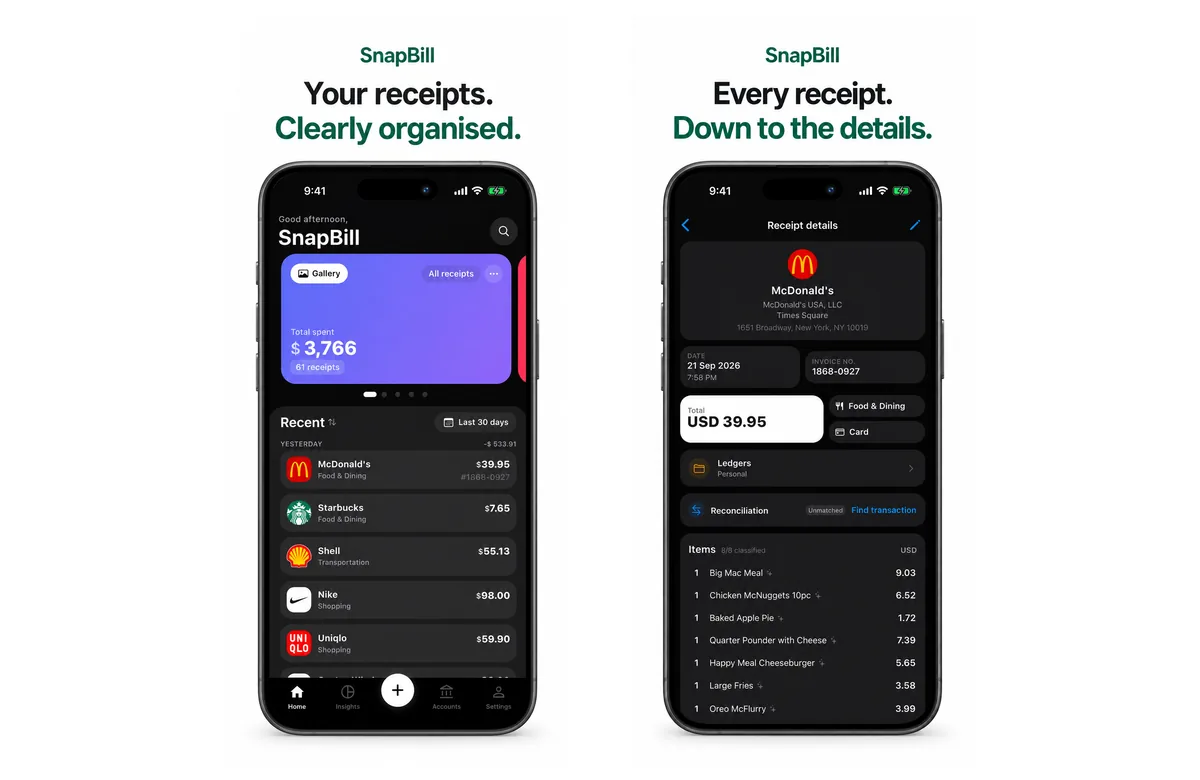
SnapBill reads every line on the receipt and keeps the service charge, SST and rounding apart from the items you ordered, so your food spending is what you actually ate. Your receipts stay in your account, ready to export as CSV, Excel or PDF. Start free on iPhone, Android or the web. Download SnapBill
More on scanning Malaysian receipts: the receipt scanner app for Malaysia. And if you keep receipts for tax, see how long to keep receipts in Malaysia.
Quick answers
What is the difference between GST and SST?
GST was a 6% tax on most goods and services, charged at every step from supplier to shop. SST is charged once: sales tax when goods are made or imported, and service tax only on listed services from registered businesses. That is why SST appears on far fewer receipts.
Why did Malaysia drop GST?
Scrapping GST was a promise of the government elected in May 2018. It cut GST to 0% from 1 June 2018 and brought back SST on 1 September 2018 (EY). No GST has been charged since.
Why don't kopitiams and hawker stalls charge SST?
Most are not registered, and they do not have to be. Food outlets only need to register once their taxable sales pass RM1.5 million a year. Without registration, a business may not charge SST.
Why do some bills show 6% SST and others 8%?
Food and drinks, telecoms, parking and a few other services are taxed at 6%. Most other taxable services, such as a hotel room, are at 8%. So a hotel bill can show both: 6% on the restaurant and 8% on the room.
Is takeaway or delivery taxed too?
Yes, if the restaurant is registered. Takeaway food, packaging charges and the restaurant's own delivery charge all carry service tax, according to the Royal Malaysian Customs Department Guide on Food & Beverages.
Does the service charge go to the staff or the restaurant?
It is meant for the staff. The Federal Court ruled in 2021 that a hotel holds the service charge in trust for its employees. The hotel cannot use it to pay their minimum wage. How it is shared depends on staff contracts, and some outlets keep back a part for breakages or staff events.
Can a restaurant charge more than 10%?
No law sets the rate, so a business can choose a different one. What it cannot do is surprise you: the rate must be shown clearly on the menu or at the entrance before you order.
Can I refuse to pay a service charge?
If it was clearly shown and you then ordered, you have generally agreed to it. If it was not shown anywhere, ask for it to be removed, and you can complain to KPDN through its e-Aduan portal.
Is SST charged on the service charge?
No. Service tax is worked out on the food and drinks only, and the service charge itself is not subject to service tax.
Are tips taxed?
No. A tip you choose to give the staff is not subject to service tax, according to the Royal Malaysian Customs Department Guide on Food & Beverages. Tipping is optional in Malaysia, especially where a service charge is already added.
Disclaimer: This article is general information, not tax or legal advice. SST rates, thresholds and scope change; check the Royal Malaysian Customs Department (MySST) for the current rules. Figures checked on 1 November 2026.